

Assess your business’s visibility in AI search with this 4-step mid-year audit covering content, trust signals, technical readiness, and Adaptive SEO strategies to help you stay discoverable in an AI-driven search landscape. Read the Blog Post Here.

Automation, Predictive analytics, Customer service AI-powered chatbot, analyze customer data, business and technology
AI Search Is Reshaping Business Visibility
As we reach the halfway point of 2026, businesses across Delaware, Pennsylvania, New Jersey, and Maryland face a rapidly shifting digital search landscape. AI-powered answer engines are reshaping how customers discover local and regional brands, making it clear that a static, “set-it-and-forget-it” web presence is no longer enough. The digital landscape isn’t waiting for companies to catch up. To thrive in a zero-click, generative AI search environment, you must evaluate whether your website, content, and digital ecosystem are prepared for Adaptive SEO visibility in the second half of the year.
If you are new to this concept, our ongoing visibility series has been tracking a profound transformation: regional businesses must pivot away from legacy search tactics to survive the rise of generative AI. To get you up to speed, winning this new digital landscape requires mastering multiple layers of optimization. It begins with analyzing how AI has stepped in as the digital gatekeeper of visibility. From there, we must map how user behavior has evolved from rigid keywords into natural conversations, why deep topical authority has replaced simple click-through rates, and how AI search engines crawl the entire web ecosystem to verify a brand. Finally, we look at the core infrastructure, proving that even a flawless brand will become invisible if its technical architecture fails to meet the strict computational demands of AI crawlers.
Now, it is time to tie all of these critical dimensions together into a singular, cohesive operational framework designed to maximize your visibility.
The AI Search Mid-Year Audit: Four Dimensions of Adaptive SEO Visibility
To ensure your business remains visible, trusted, and recommended through the end of the year, your digital footprint must adapt across all four layers of the new search ecosystem:
1. Navigating the Gatekeeper (The New Search Reality)
Platforms like ChatGPT, Google AI Overviews, and Claude are the new gatekeepers between your business and your customers. Traditional search gave users a list of ten blue links to choose from. Generative search is completely different; it synthesizes data on the fly to give the user one direct answer or a highly curated recommendation.
The Mid-Year Check: Are you still optimizing your digital strategy entirely around traditional click-through rates? In a “zero-click” era, if you aren’t being surfaced or cited in AI-generated results, you’re dramatically reducing your opportunity to influence buyer decisions. To secure long-term Adaptive SEO visibility, we have to measure success by how frequently your brand appears, is referenced, and is cited within AI-generated answers.
2. Intent Over Keywords (The Content Strategy Shift)
User behavior has shifted. The era of typing rigid, fractured phrases into a search bar is fading; users now type complex, multi-turn, natural language questions.
The Mid-Year Check: Audit your current content library. If your website is still relying on thin service pages stuffed with regional keywords, you may be optimized for a version of search that is quickly fading. To win the visibility battle, you must build robust topic clusters that mirror real-world conversations and completely answer consumer intents. AI systems are more likely to surface content that demonstrates depth, clarity, and topical authority, not thin pages built around superficial keyword targeting.
3. Ecosystem Verification (The Trust Factor)
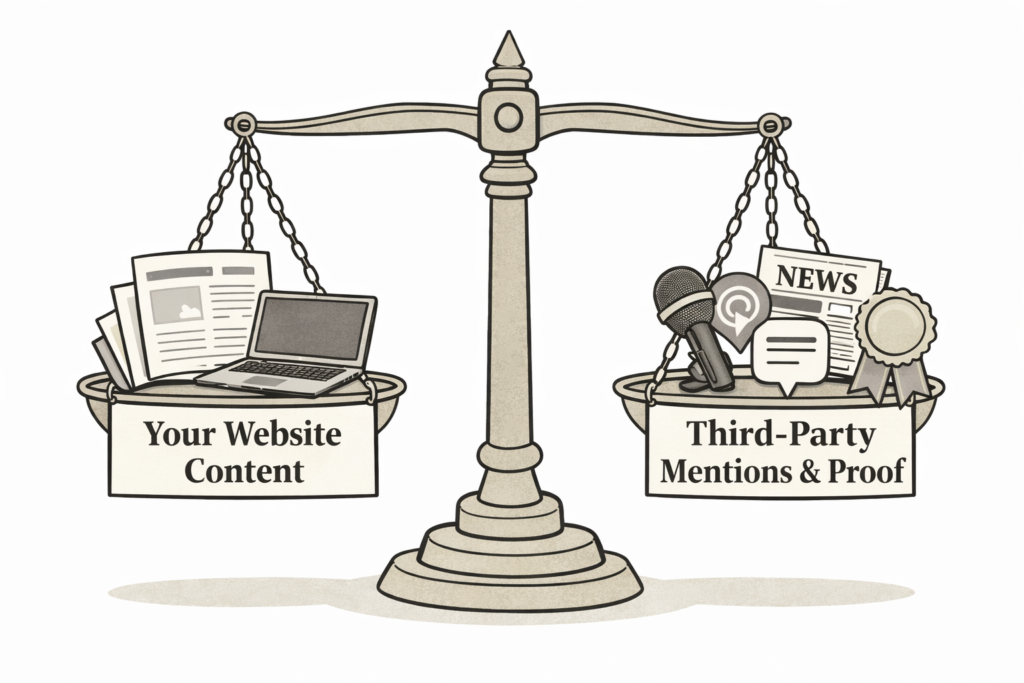
AI engines formulate recommendations by acting as digital investigators. They don’t look at your website in a vacuum. Instead, they aggregate and validate data from across the entire digital ecosystem. They cross-reference signals from your Google Business Profile, industry directories, local reviews, social platforms, and your website. The more consistent those signals are across the web, the more confidence the system has in recommending your business.
This process closely mirrors Google’s EEAT framework (Experience, Expertise, Authoritativeness, and Trustworthiness). AI systems increasingly rely on these same trust signals when determining which businesses deserve visibility, citations, and recommendations.
The Mid-Year Check: Is your business information flawless and identical across all regional networks? Inconsistencies across different platforms breed algorithmic distrust, making it less likely that AI systems will confidently include your business in recommendations.
4. Retrieval Readiness (The Architectural Foundation)
The ultimate bottleneck for visibility often hides in your technical infrastructure. You can have brilliant content and perfect ecosystem trust, but if your site relies on legacy Client-Side Rendering (CSR), you are forcing AI bots to spend heavy compute power to parse your code.
The Mid-Year Check: True Adaptive SEO visibility requires a site optimized for immediate machine readability. By utilizing Server-Side Rendering (SSR), you deliver fully rendered content from the very first request, ensuring your Schema markup is instantly accessible. This closes the Attribution Gap—the structural flaw where an AI uses your unique insights but gives the citation link to a competitor whose site was simply easier to crawl and verify.
Your Action Checklist for AI Search Visibility
To close out the first half of the year strong, run your web presence through this four-step checklist:
- Audit for Conversational Intent: Review your top services. Do you have dedicated content that answers the complex, long-tail questions your customers actually ask in real life?
- Clean the Brand Footprint: Clean up outdated directories and ensure your brand name, address, and core services are identical across the web to build algorithmic trust.
- Flip the JavaScript Switch: Turn off JavaScript in your browser and check your pages. If your primary content or structured Schema Graphs vanish, your site is invisible to AI machines.
- Deploy an AI Roadmap: Consider implementing an
llms.txtfile as part of your broader AI-readiness strategy, ensuring it is hosted on a fast, SSR-supported directory so crawlers can ingest your assets without friction. While adoption is still evolving, it can serve as an additional machine-readable guide to your most important content.
The AI Search Reality Check: Adaptive SEO Requires Active Management
The shift to agentic, AI-driven search isn’t a temporary trend or a minor algorithm update; it is a permanent realignment of how local and regional industries connect with consumers. The technical, content, and trust gaps hiding within your digital footprint may already be limiting how often AI systems discover, cite, and recommend your business. The sooner those gaps are addressed, the stronger your Adaptive SEO visibility becomes for the second half of the year.
Follow Along With Us
This blog is part of a broader effort to help local businesses understand and navigate the changes happening in search. If you want practical, clear insights you can apply without becoming an expert, follow along with us as we continue breaking down the evolution of search in ways that support your success.
Learn More About The New Search Landscape
If you want a deeper strategic perspective on the evolution of search, you may appreciate
The AI Search Revolution: Adaptive SEO in the Age of AI by Dan Monaghan, available on Amazon. It is not required reading, but it provides additional context and industry perspective.
If you want your business to become more visible, more trusted, and more likely to be cited in AI-driven search results, the team at Famous WSI Results is ready to help. you optimize for the AI-driven web.
Let’s secure your visibility for the second half of the year.
- Call: (302) 407-0430
- Visit: https://famouswsiresults.com

Leave a Reply