

Search has shifted from keywords to conversations, with AI focusing on intent rather than exact phrases. This article explains how businesses in Delaware, Pennsylvania, Maryland, and New Jersey can stay visible by answering real customer questions clearly. Read the full blog post here.

From Keywords to Conversations
For years, showing up online meant choosing the right keywords and placing them in the right spots. That approach worked because search engines matched words to pages. But that approach is fading. Today, search is shifting from keywords to conversations, and for businesses in Delaware, Pennsylvania, Maryland, and New Jersey, that shift is already influencing who gets discovered and who gets overlooked.
In the last post, we explored how artificial intelligence has become the gatekeeper of visibility. Now, the focus moves to how AI tools make those decisions. Modern search systems do not just scan for matching terms. They interpret meaning, context, and intent. And ultimately, they decide whether your content sounds like a real answer to a real question.
Keywords to Conversations: Search Is No Longer About Matching Words
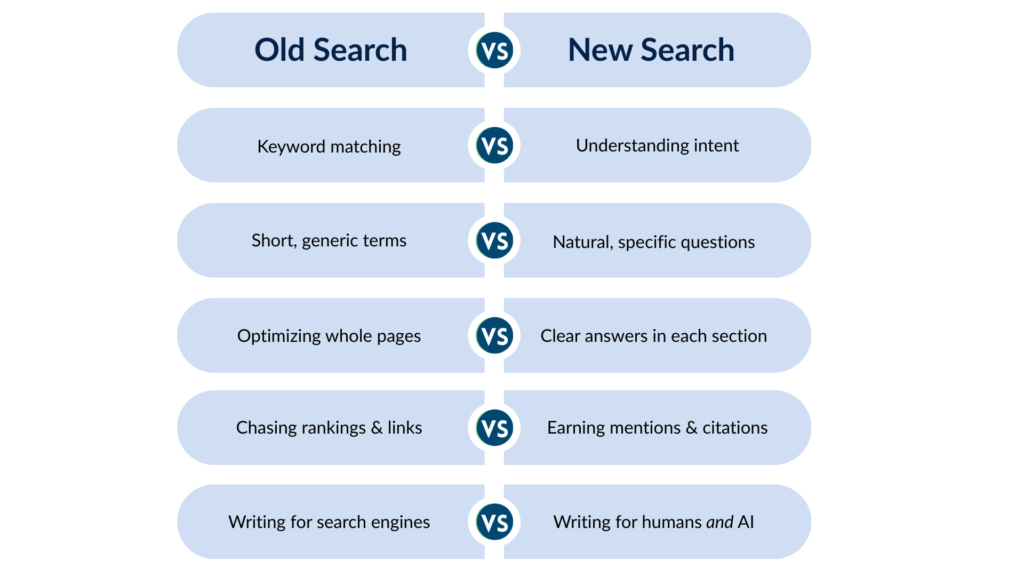
Traditional search rewarded repetition. If someone searched for a service, like “plumber near me,” the page that repeated the right phrase often, or those exact words in the right places, won.
However, AI does not work that way.
Modern search systems focus on what someone is trying to solve, not the words they use to describe it. When a customer asks, “Who can fix a leaking pipe before my basement floods,” the system looks for content that clearly addresses urgency, location, and capability. A page does not need to repeat a phrase to be useful. It needs to clearly address the problem behind the question.
This is why keyword-heavy pages that feel robotic often underperform, while simpler explanations perform better. AI is not impressed by repetition. It is looking for understanding. If the content feels generic or unclear, AI has little confidence using it as part of an answer.
Why Real Questions Matter More Than Keywords
People do not think in keywords. They think in problems.
Instead of short phrases, they ask questions such as:
- “Who can repair a roof quickly in Wilmington before the next storm?”
- “What is an easy accounting system for a small business with no finance staff?”
- “Who installs patios that last through winter in New Castle County?”
AI systems are trained on this kind of natural language. When your content reflects how people actually ask for help, it becomes easier for AI to match your business to the question.
You do not need special tools to find these questions. They already appear in customer emails, contact form messages, reviews, and phone calls. When your website reflects the language people actually use, you increase your chances of being selected.
How AI Decides What Belongs in the Answer: Keywords to Conversations
When AI generates an answer, it does not scan the entire internet in real time. It favors content that is easy to understand and easy to reuse.
In general, AI looks for:
- Clear explanations
- Focused answers
- Consistent messaging
- Simple structure
Content that wanders or relies on vague marketing language is harder to interpret. Content that clearly explains what you do and how you help gives AI confidence.
This does not mean your writing needs to be technical or long. In fact, simpler explanations often work better because they remove guesswork.
An added bonus, this kind of simple, clear, explanation is not only easier for AI to digest, its easier for your customers to understand as well.
FAQs and Structured Answers Make You Easier to Find
One of the most effective ways to support conversational search is through structured answers, especially frequently asked questions.
Strong FAQ sections:
- Use real customer questions
- Provide direct, complete answers
- Focus on one idea at a time
- Avoid filler language
This structure helps AI recognize that your business understands common problems and can explain solutions clearly. It also makes it easier for your content to be pulled into answers when similar questions appear elsewhere.
What This Means for Local Businesses
This shift does not automatically favor large brands. It favors clarity.
A local business with fewer pages but better explanations can outperform a larger competitor with more content but less focus. AI does not measure effort. It measures usefulness.
For businesses across Delaware, Pennsylvania, Maryland, and New Jersey, this means fewer, better answers often matter more than publishing more content.
Follow Along With Us
This blog is part of an ongoing series about how artificial intelligence is changing the way people find businesses. If you want clear and practical guidance in everyday language, follow along with us. We will continue exploring how this shift affects local businesses in Delaware, Pennsylvania, Maryland, and New Jersey.
Learn More About The Shift From Keywords to Conversations
If you want a deeper look at how search is evolving, you may find The AI Search Revolution: Adaptive SEO in the Age of AI by Dan Monaghan helpful. It is available on Amazon. It is not required reading, but it offers broader context for this series.
We Can Help
If you want to understand how the shift from keywords to conversations affects your business and how to adapt without chasing trends, the team at Famous WSI Results can help.
We work with businesses across Delaware, Southeastern Pennsylvania, and Northern Maryland to build digital strategies that make sense to people and to AI systems.

Leave a Reply